

liquid Spells: THE SORCERY OF PORTLAND'S DARKEST Brewery
How Sam Zermeño turned a long-brewing vision of haze, ritual, metal, and visual myth into one of the Pacific Northwest’s most distinctive breweries.
BRUJOS
A few minutes before noon...
...on a Saturday in February 2024, the line snaked from the loading dock of an unmarked warehouse off NW Wilson Street and curled toward an I-405 off-ramp. The hundred-plus people standing in the cold weren’t waiting for sneakers, doughnuts, or a pop-up coffee shop. They were waiting for beer — specifically, for a few hundred cans from a brewery that didn’t yet have a front door.
Two months later, when Brujos Brewing did open its front door, the doors swung onto a blackened sanctuary lit by Victorian chandeliers, with grim reapers stationed at the threshold and gothic-metal lettering glowing in cold blue above the bar. By the following year, the Oregon Beer Awards had named Brujos its Best New Brewery of 2025.
This is a piece about how that happened. It is also a piece about a quieter trend in American craft beer — one that has been gathering momentum for a decade and now arguably has its first cathedral. The most ambitious new breweries no longer treat aesthetic as marketing. The label art, the music, the merch, the room itself, even the people pouring the pints — all of it is the product.
From a driveway in Riverside

Zermeño was born in Tijuana and emigrated to Southern California with his family at age eight, eventually settling in Riverside. He was never a born brewer. He was a truck driver who loved art, tried to start a skateboard company at fifteen, and wanted, above everything, to be in a band. “Before I started making beer I wanted to be in a band, to be a rockstar and shit,” he has said. “That just didn’t really work out.”
What did work out — though it didn’t feel like luck at the time — was a rock-climbing accident in 2014 that shattered both of his ankles and put him in a wheelchair for roughly six months. “When I broke my feet I was kind of depressed and losing my mind,” he later told KGW News. “Brewing kind of saved me from my thoughts and my inner darkness.” His brother became his hands for the heavy lifting on those first homebrews; their mother came over to keep an eye on the two of them. The first batch — a recipe called Hex he found on a can of malt extract at a homebrew shop — came together in his family driveway. He was hooked.
The name for the project arrived in the same driveway. Zermeño’s father stepped outside, saw his sons hunched over a steaming kettle, and said: “Look at you two. You look like brujitos making magic potions.” In Spanish, brujos means sorcerers or warlocks. Zermeño didn’t know yet what the project was going to become. He just knew he had the name.
A Long Spell in the Making
To understand Brujos, you have to understand that the metal influence isn’t a vibe lifted from a moodboard. It’s a biography. Zermeño grew up in the Tijuana–Southern California alternative underground and found his community in gothic metal culture at a time when, by his own description, he was a loner. “I really fell in love with the culture, and the sharing of ideas. I was a loner growing up, so this felt like home,” he told New School Beer.
In a recent interview with Fermented Metal, he listed his early teen musical tastes:
In my early teens, I was listening to a lot of punk rock and hip hop. Artists like AFI, Tiger Army, Danzig, The Misfits, Pennywise, DMX, Tupac, Bone Thugs, etc. It wasn’t until my late teens that I started delving more into the metal music realm.
- Zermeno
The tastes that have stuck with him are the ones at the genre’s strangest fringes: black metal, doom, drone, sludge, dungeon synth, ritualistic and dark ambient. Those aren’t throwaway references. They map directly onto Brujos’ aesthetic DNA — the coldness, the slowness, the density, the occult aesthetic. The same sonic palette that produces Mayhem, Electric Wizard, and Sunn O))) finds its visual equivalent in Brujos’ cloaked figures, runic typography, and a taproom designed to feel like a desecrated or “burnt cathedral”.
When homebrewing finally clicked, Zermeño saw the crossover instantly. “The moment I started brewing, I thought, ‘This is it. This is the shit,’” he told Good Beer Hunting in 2024. “The whole process of brewing was very whimsical, the mashing in and the steam and the pots just looked super cool. I thought, now I can apply all the witchy shit that I’m into, the dark metal and the psychedelic rock and roll.”
It’s worth saying, because Zermeño says it himself: Brujos is not Satanism. The term brujo is rooted in Latino, Caribbean, and African folk-magic traditions — healing practice, not horror. The black-metal visual language is a chosen cultural framework, not a creed. The point of the imagery, like the point of metal itself for a kid in Riverside, is belonging.


From Driveway to Industry
Most homebrewers are content to hand-fill a few corny kegs and call it a hobby. Zermeño started designing professional-grade label art for his first batches and posting them online — long before he had any business doing so. Friends began trading his bottles for commercial beer; people tagged him on Instagram. The work read like a fully-formed brand years before any of it was legal.
In 2016, his friend Kyle Boruff hired him as an assistant brewer at Black Market Brewing in Temecula, California, where Zermeño says he learned “all the ins and outs of keg-washing and canning and transferring and CIP, all that shit.” A stint at the newly opening Newport Brewing Company on the Oregon coast convinced him to relocate to the Pacific Northwest. He landed in Portland and, in March 2020 — the day the pandemic shut the city down — started as a production lead brewer at Great Notion Brewing, then arguably the most celebrated hazy IPA brewery in the region. He eventually rose to R&D brewer. Two GABF gold medals are on his CV: one for a hazy double IPA at Black Market in 2018, another for Feniks, a grodziskie he developed at Great Notion.
In 2022, rather than leave Great Notion to launch Brujos independently, Zermeño proposed a partnership: Great Notion would handle licensing, infrastructure, packaging, and distribution, while he would formulate and brew everything under the Brujos name. "It reminded me of an artist getting signed to a record label," he says. The first commercial release — a hazy IPA called Sitra Achra, Kabbalistic for "the other side" — sold out the day it dropped. "Sitra Achra was our first hit single," Zermeño recalls. The lines followed him when he later moved Brujos's contract production to Living Häus Beer. "Sales didn't start until noon," Living Häus co-founder Mat Sandoval told Good Beer Hunting. "Eventually, we started to go get donuts and just hand them out to people waiting in line."

The Order of the Magus
Before any of that — before the licenses, the lines, the partnership — Brujos circulated through an invitation-only club Zermeño called The Order of the Magus. Fewer than a hundred members split batches of roughly 130 bottles or cans per release. Members made donations to causes of Zermeño’s choosing in exchange for covering his overhead. It was part homebrew club, part underground collective, part metal-zine — access by community, not commerce. The structure and identity were built in collaboration with Portland design studio Perfect Strangers Design, which developed the club’s branding, glassware, merch, and special-release labels — making Brujos, even at that small scale, a fully designed object.

The Scorched Church
In July 2023, Zermeño partnered with Jesse McFarland — a longtime Great Notion regular and boat broker who had quietly admired his work for years — and Scott LeMaster, an insurance executive turned craft beer obsessive, to lease the vacated Hammer & Stitch Brewing space at 2377 NW Wilson Street. What followed was eight months of transformation. A starkly white brewpub was stripped, blackened, and rebuilt into what Zermeño calls his “scorched church.”
The taproom is, plainly, the most theatrical in Portland. Willamette Week described it as “the doom-metal garage club you discovered after reading a handwritten flyer in the restroom of a dive.” Salvaged church pews and a pulpit from a Southern Oregon church remodel anchor the seating. Abbey-style arched windows cut through a false wall to frame the brewing system. Massive Victorian chandeliers drop through fog that rolls along the floor on busy nights. A mural lifted from the can art of Void Nectar — a skull bleeding gold from its jaws — dominates one wall. Cloaked grim-reaper figures with lanterns, sickles, and mash paddles look down from above. New School Beer’s Ezra Johnson-Greenough wrote that the gothic arches over the bar look like “Barad-dûr, the Dark Tower on the Plateau of Gorgoroth in Mordor” — a comparison the proprietor would presumably take as a compliment.
The brewery’s slogan, “crafting liquid spells,” is not subtle, but it is accurate. Everything about Brujos is built to reinforce that idea: the names, the label art, the characters, the social media presentation, the event programming, and the room itself. Many breweries have striking design. Few maintain a coherent aesthetic across architecture, branding, merchandise, costuming, and product identity as completely as Brujos does.

From Beyond a Brewery
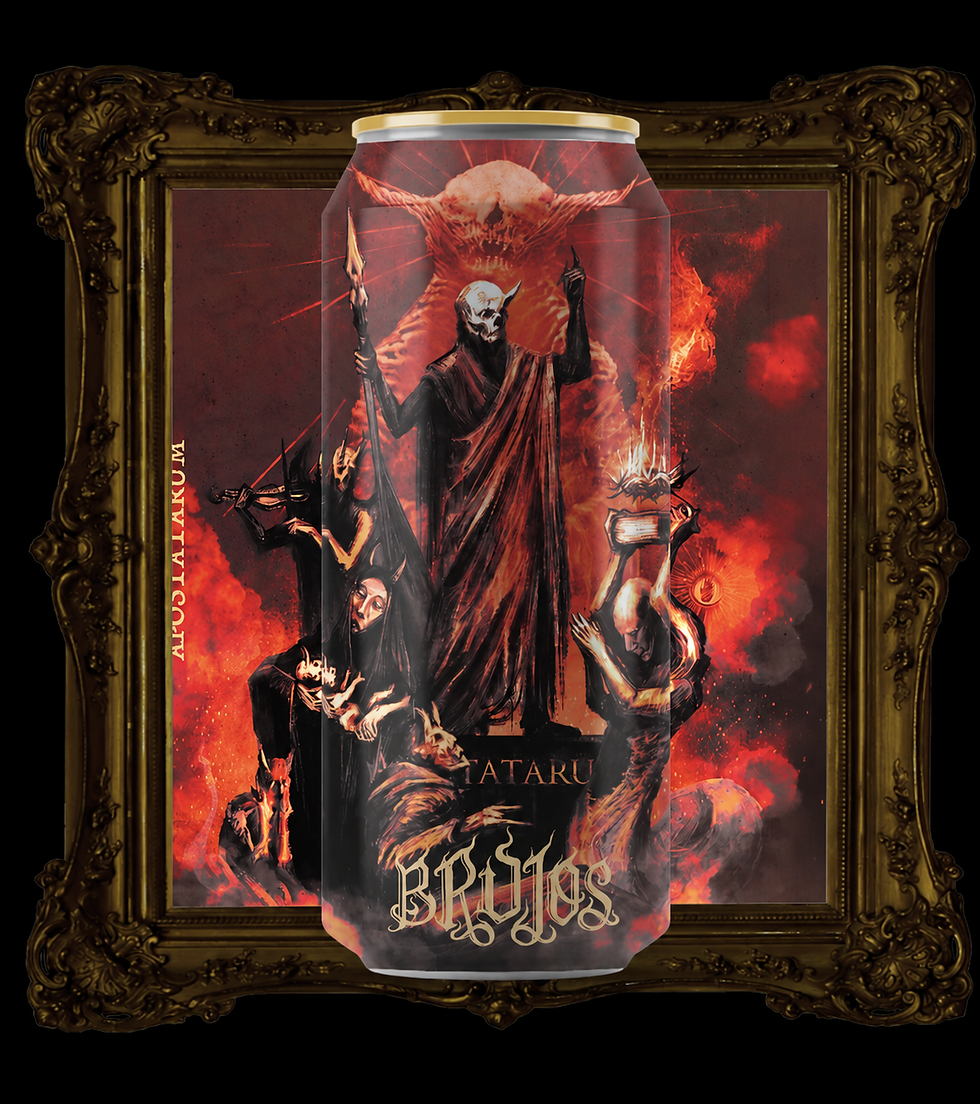
The most overlooked element of the Brujos universe is also the part that most clearly distinguishes it from any other brewery: the costumes. Brujos has its own sorcerer characters — Señor Apostata and The Lord of the Scorched Church — fully realized, robed and masked figures who appear in Instagram videos and at events.
Asked which artists he most enjoys working with, Zermeño named three by hand. Tristan of Majesty Black, a custom glove designer whose work runs in the leather-and-metal cathedral of contemporary occult fashion. Alexandra Groover, the fashion designer known for sculptural, blackened, ceremonial garments. And Jonathan Becker, a mask creator. Together, those three have built the wardrobe for the Brujos characters. It is a level of investment in physical, wearable identity that almost nothing in beer culture matches. A craft brewery hiring a couture mask-maker isn’t a pivot to gimmick; it’s a brewery treating the live show as part of the recipe.
That instinct extends outward. Zermeño told Fermented Metal,
“I’m honestly more interested in collaborating with people outside of the beer world at this point,” . “Artists, musicians, writers, fashion designers — which we have been doing a lot of lately.”

Beers as Scripture
If the Scorched Church is the cathedral, the cans are its scripture. Zermeño has always treated label art as the equal of the liquid inside, and the through-line is unmistakable: cloaked figures, skulls, runic typography, occult symbols, an obsidian-and-gold palette. Void Nectar gave the taproom its centerpiece skull. Early releases like Famine — a rye bourbon barrel-aged imperial pastry stout treated with vanilla beans, cacao nibs, marshmallows, and graham crackers — and Holy Death wore names from the darkest corners of the doom and occult traditions.
Read across the catalog, the beer names work like a curated metal playlist crossed with a grimoire. Sitra Achra invokes Kabbalistic demonology. Mortis Imperium sounds like a death-metal track title. Necromanteion takes its name from the ancient Greek oracle temple of the dead. Wolfenthrone, a West Coast IPA brewed with Portland’s Ruse Brewing, reaches straight into the symphonic black-metal lexicon — one compound word that could pass for a Dimmu Borgir B-side.
The single most musical name in the Brujos catalog is also the most quietly clever: Cirice, a pilsner named after the 2015 Grammy-winning single by Swedish occult-rock band Ghost. Asked plainly whether the beer was a Ghost reference or a coincidence, Zermeño answered:
“Absolutely inspired by Ghost. The can art just reminded me of them so much, it seemed like a fitting name.”

The song’s title is Old English for church, and Ghost’s whole apparatus — robes, anonymity, gothic pageantry — mirrors the Brujos universe almost exactly.
Shiva Honey nods to a figure prominent in the modern Satanic arts and music scene; Sitra Achra reaches into Jewish mysticism. The names show depth of consideration and understanding, much like the beers themselves.

Sitra Achra from @brujos_brewing
9.2% Triple dry hopped Imperial Hazy India Pale Ale brewed with Citra Incognito, Citra Cryo, Citra Lupomax, & Citra T-90

Brewers of the Same Tongue
Collaboration has been part of Brujos’ DNA since the underground years, when team-ups were one of the only ways Zermeño could get beer into people’s hands at all. The list now reads like an honor roll. The blue-chip side of American hazy IPA — Monkish, Trillium, Other Half, Troon, North Park — joined Brujos for a six-brewery triple IPA called Three Times Three. Sweden’s avant-garde Omnipollo collaborated on a triple-dry-hopped TIPA called The Beginning; the same project later expanded with The Eighth State and Troon into Graveyard Shift, a multi-variant imperial stout that became one of the most-traded beers in underground beer circles. The annual 3-Way IPA with Fort George and Ghost Town has become one of the Pacific Northwest’s most anticipated limited releases. Beer Zombies of Las Vegas brought a triple hazy IPA marketed as a meeting of “a Wizard and a Zombie,” leaning hard into the horror-metal iconography both brands share.
But the most revealing brewery collaboration may be with Holy Mountain Brewing, the Seattle outfit long understood as one of the craft beer world’s most metal-adjacent brands. Their Garden Green fresh-hop IPA was named directly after a song by Chicago psychedelic doom band REZN. The label, designed by Holy Mountain’s Ryan Williams and featuring bones, a cloaked reaper, and what Williams called “a not-so-discrete allusion to weed,” was named one of Hop Culture’s ten best beer labels of 2024. Williams cited High On Fire’s Electric Messiah artwork as a direct color reference. “Some of my favorite labels come together when the only guidelines are: What about something with the greens from the eyeballs on High On Fire’s Electric Messiah?” he said. That’s not a brewer playing at metal aesthetics. That’s a brewer and an artist speaking the same fluent language.
Zermeño’s own running list of dream collaborations is similarly specific. He has said that his white whale on the brewery side is Monkish — “I’m a big fan of Henry and Adriana. That would be a full circle one for me for sure.” And, as he told Fermented Metal, his early-brewing inspiration was shaped less by beer connoisseurship than by the idea of beer,
I was always intrigued by Stone’s beer labels (San Diego’s Stone Brewing) and slogans such as “you’re not worthy.” The devil’s temptation eventually got to me, I wanted a bite of that apple so I tried it, and while I absolutely hated those beers at first, I eventually came around to enjoying them. - Zermeño

The Portland Metal Feedback Loop
On the band side, Brujos is not standing still. Zermeño confirmed that the brewery recently made an American Light Lager with the band Hell, scheduled for release at the brewery’s “El Día de los Seises” event on June 6, 2026. That adds to Brujos’ growing pattern of folding music directly into its releases and public-facing programming. Brujos’ event programming has become one of its most distinctive strengths.
As far as local Portland bands go, I’m a big fan of Mizmor, Hell, Agalloch, Tithe, Wraith Knight & Hail. All bands who we’ve worked with. As a matter of fact, we’re throwing a big block party on 6/6/26 on our street and Tithe, Wraith Knight, and Hail will be performing on an outdoor stage that we’ve rented for the event. Jason of Agalloch has been helping us set up events like these lately and we’re so thrilled to have him on board. - Zermeño
These are not casual in-house happenings but organized public events that merge live music, beer releases, and scene gathering. Brujos has increasingly treated its brewery not just as a taproom, but as a venue for ritualized community activity.


Moving Forward, Outward
Brujos Brewing’s has announced an “Imperial Tour” across China for a 2026 international tap-takeover push by the Portland, Oregon brewery, built around a limited run of Imperial Hazy IPAs brewed specifically for the trip. In posts and event listings tied to Brujos’ “El Día de los Seises / Sixes Day” celebration, the brewery said the China tour would include “multiple cities” and tap takeovers, while offering fans in Portland an early taste of the beers before they head overseas. The tour fits Brujos’ broader identity: a highly stylized, gothic, metal-adjacent brewery known for hazy IPAs, dark visual branding, collaborations, and a cult-like following that has helped turn the young Portland brewery into an internationally noticed name in modern craft beer.
Why Brujos Matters
It would be easy to read Brujos as a stylized one-off — a Portland goth bar that happens to brew lager. The reading doesn’t hold up if you actually pay attention to how the place is built. Zermeño isn’t borrowing from metal. He grew up in it; he listens to it; he names beers after the songs and theologies he believes in; he hires the actual fashion designers and mask-makers who dress the actual characters who appear at the actual events that the actual bands play. The aesthetic, the music, and the product are not three separate things stitched together in a brand book. They are one thing.
That coherence is what’s increasingly missing from craft beer at large, which is why the breweries that have it — Holy Mountain in Seattle, Burial in Asheville, and now Brujos in Portland — feel like outliers and standard-bearers at the same time. Brujos is the most fully-committed example yet. The result is a brewery that reads less like a company and more like a band’s discography, a fashion line, and a religion all at once. Oregon Beer Awards’ Best New Brewery for 2025, sure. But on the evidence in the room, also the new template.
Portland has many good breweries. Brujos has become something rarer: a brewery with a worldview. Its success suggests that people still want more from beer than flavor notes and trend cycles. They want atmosphere. They want meaning. They want a place that feels like it was made by people who believe in something. Brujos Brewing, for all its darkness and theater, offers exactly that.


2377 NW Wilson Street, Portland, OR 97209
Sun-Thurs: 11 am - 9 pm
Fri-Sat: 11 am - 10 pm
[21+]
brujos.bigcartel.com
Instagram: @brujos_brewing
