
Out of the Mists: Ūkanose on Folklore, Folk Metal, and Fourteen Years of Kilkim Žaibu

Updated: Jul 12
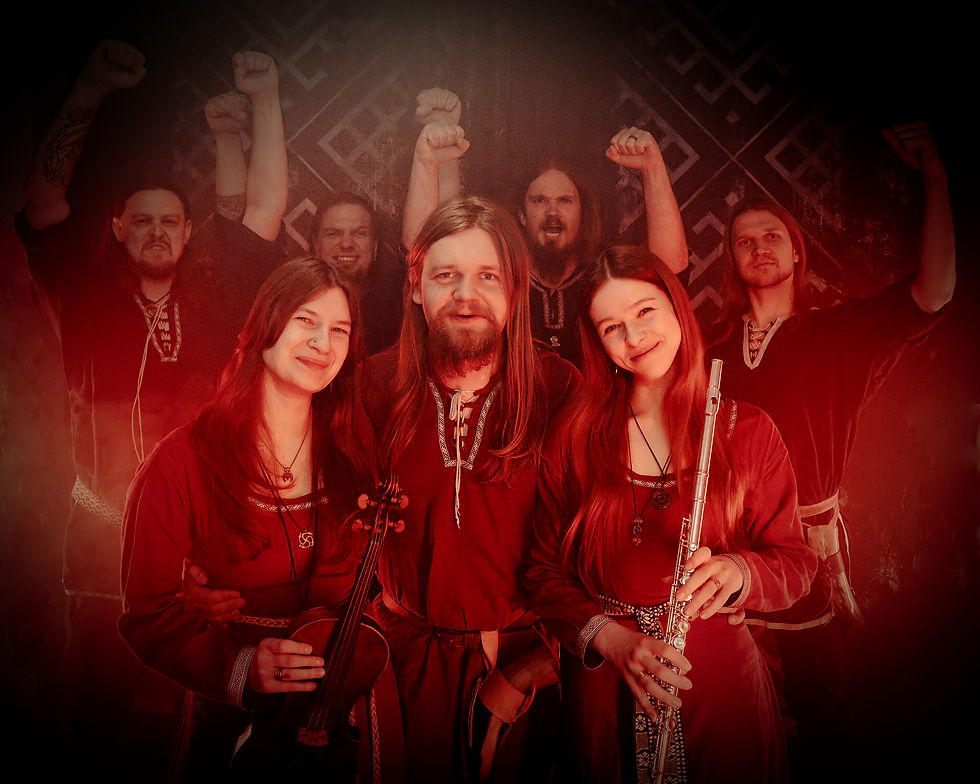
I missed connecting with Ūkanose at the 2026 Kilkim Žaibu Festival for an interview. I thought I'd catch up with them during the "13:00–15:00 Meet the Bands at the Lecture Tent' , no bands showed up. However, I did get to see them live, and the crowd was electric, lots of energy! So, not getting an interview hit even harder, it felt like a professional failure....
Until, a day or so later, my phone started buzzing with a Lithuanian number I was fairly sure was spam. I did not answer on the first few calls, until I did. On the other end was Linas Petrauskas — guitarist and founding member of Ūkanose — tracking me down on his own initiative to make sure the interview happened anyway.

By then I had already relocated to Kaunas. Linas drove out to meet me at my hotel regardless, showing up a little after 11 p.m. despite having to be at work the next morning, and bought the first round before I could stop him. We took our beers outside, away from the noise of the hotel bar, and found a quiet corner against the backdrop of Kaunas at night.
Linas, it turns out, is not only the guitarist of one of Lithuania's biggest folk metal exports — he also works in metal production by trade, and carries a more literal kind of metal in his own feet, the legacy of an old accident that has since limited how much he can throw himself into the historical reenactment scene he loves. It felt like an unusually fitting detail for a magazine with "metal" in its name twice over.
Before we got anywhere near a formal question, we had already covered his early influences: Zpoan Vtenz, the shape-shifting Lithuanian black/folk act behind 1997's Gimė Nugalėt; Ha Lela's folk-inflected black metal; and Obtest, the Vilnius pagan-black metal outfit that has been flying the flag for Lithuanian heathen metal since 1992 — longer than almost anyone else in the scene, and still the country's most commercially successful black metal band. We talked, too, about what it meant to be a metalhead in a Lithuania still shadowed by organized crime, when the wrong T-shirt and long hair on the wrong street could get you "knocked on the head." It was against that backdrop, Linas told me, that Ūkanose's story really begins.
Two Metalheads at a Pub
Ūkanose formed in Vilnius in 2012, though the roots go back a year earlier, to a university lecture hall. I asked Linas what he remembers most clearly about the band's beginning.
Linas:I vividly remember meeting up with Tadas Survila at the Apuokas pub to sing Lithuanian folk songs. We'd sit down in the basement with big mugs of beer and spend hours singing songs on all kinds of themes. Those evenings are some of my strongest memories from that time. I also remember our very first rehearsals as a band. At the beginning, we didn't even have a drummer—he joined about a month later. It was actually pretty funny because, at first glance, he looked much more like someone who was into rap or electronic music than metal or rock. We quickly realized we were completely wrong. As the saying goes, don't judge a book by its cover. In 2012, we played our first three concerts, and I have to say the parties after those shows were unforgettable.

The Tadas Survila in question is the same musician Linas first sat next to on the first day of university, September 1, 2011 — a chance seating arrangement that, by Linas's account, became the whole reason Ūkanose exists.
Linas:I first met Tadas on September 1, 2011, when I sat down next to him on our first day at university. He looked different from most of the other students, so I immediately thought, he's one of us. It wasn't until a few months later that I found out he was one of the founders and members of the well-known Lithuanian folk rock band Brėkšta. After I was kicked out of the band I was playing with at the time, Tadas asked me the very next day if I was still playing folk metal. I told him, 'I was until yesterday—but not anymore, because I got kicked out.' He suggested we sit down and talk about making music together. We quickly realized we had a lot in common: folklore, metal, history, mythology, paganism, beer, and simply having a good time together.

It took a while, Linas said, before he could put his finger on what the "Ūkanose sound" even was — and the moment he finally recognized it happened, fittingly, in someone else's rehearsal room.
Linas:To be honest, I never really stopped to think about what the 'Ūkanose sound' was. It simply exists—it developed naturally over time. I do remember one moment that made me realize our sound had become recognizable. I was auditioning for another band that I later joined, Andaja, and when their keyboard player walked into the rehearsal room, she said, 'Play differently—I can hear Ūkanose, not Andaja.' At that moment, I thought, Aha... so we really do have a recognizable sound. That made me smile.
Building the Ūkanose Sound
Folk metal is a genre built on a wager: that centuries-old melodies and modern distortion actually belong together. I asked Linas how the band settled on its particular balance of the two.
Linas:Lithuanian folk music is incredibly diverse, so finding the right balance has never really been a challenge. There are plenty of melodies that already sound heavy and powerful, while others are bright, lively, and joyful. I think Lithuanian folklore lends itself naturally to metal music. Many authentic folk melodies can easily be transformed into great black metal riffs. Our traditional music makes extensive use of minor keys and dissonant intervals, especially seconds, which fit surprisingly well within extreme metal.
That synthesis shows up most explicitly on "1236," a track from the band's 2023 album Šiaurum Vėjum. The number refers to the Battle of Saulė, fought on September 22 of that year, when a coalition of pagan Samogitian and Semigallian forces annihilated the Livonian Brothers of the Sword — killing somewhere between 48 and 60 knights, including the order's master, and effectively ending it as an independent military force. Lithuania and Latvia now jointly mark the date as the Day of Baltic Unity. It is exactly the kind of victory Linas says the band feels compelled to keep alive in song.
Linas:Of course, our songs tell stories about historical events, our battles, and our greatest victories. For example, our song '1236' is dedicated to commemorating the Battle of Saulė. We are proud of our homeland and we deeply love our country, its history, and its culture. Our nation is a nation of warriors that has fought for many centuries, but at the same time, we can see that our ancestors also knew how to celebrate and enjoy life. That is why our repertoire includes not only serious and melancholic songs, but also very joyful ones—songs that make people want to dance, sing, and celebrate together. It is also worth mentioning that we have many humorous folk songs about brewing alcohol, drinking, and what happens afterwards.

Money, Motivation, and Seven Calendars
No band survives fourteen years on inspiration alone. I asked what were the biggest challenges in keeping Ūkanose active during the first early years.
Linas:During the first years, the biggest challenge was money. Everything was expensive, especially for students. We needed good instruments, and we also had to pay for rehearsal space. It was also difficult to keep everyone in the band motivated and interested after one setback or another. I think the hardest part was simply not giving up whenever we faced an obstacle.
Ūkanose currently carries seven members — well above the standard metal-band headcount, and a logistical headache Linas doesn't pretend away.
Linas:Having seven members in the band means we have to plan our concerts, tours, and all other activities more carefully. Seven people means seven separate calendars, because everyone has their own jobs, other activities, families, friends, and personal interests. We try to know about our upcoming events as early as possible—at least six months in advance, and sometimes even a year before a show—to understand whether it will happen or not. So far, I think this strategy has worked very well for us.
That planning has paid off on stages well outside Lithuania. Despite singing almost entirely in Lithuanian, Ūkanose has built audiences across Poland, Germany, Latvia, Romania, and France.
Linas:I believe that music is a universal language. We were pleasantly surprised that people are eager to come to our concerts and listen to us wherever we play. After the shows, people often come up to us and share what they liked, what caught their eye or ear, and ask what a particular song is about. The Lithuanian language is very melodic and naturally suited for singing, so we are no exception. For international listeners, hearing Lithuanian is a kind of unique experience.
The Hottest Show of Their Lives
When I asked Linas to name one of the most meaningful shows in the band's history, he didn't reach for a milestone release or a foreign capital. He reached back to the beginning, and last month.
Linas:It is difficult to choose just one particular performance. Some of the most memorable shows would probably be our very first concert, simply because it was the beginning of everything, the album release show for 'Šiaurum Vėjum', and Kilkim Žaibu 26/06/2026 (lots of 6's in there?), because it was unbelievably hot and we left every bit of our energy on stage. It felt like the audience truly appreciated it, because it became a huge celebration not only for us but also for everyone who was there.

"Unbelievably hot" is an understatement. Kilkim Žaibu's 26th edition ran June 25–27 at the Lėnas lakeside in the Ukmergė district, on the grounds of the Antanas Smetona Manor Museum — the same weekend a record-breaking heatwave settled over Europe and pushed Lithuania to an all-time June temperature record of 36.3°C, breaking the previous mark of 35.7°C set in 2019. Every band on that bill was playing through the same air; Ūkanose simply appear to have made better use of it than most.
This magazine caught the set firsthand: a 4 p.m. slot on the Perkūnas stage that Friday, June 26, which drew one of the largest crowds of the day. Live, Ūkanose builds its set around sutartinės and other traditional Lithuanian singing forms worked into heavy, guitar-driven arrangements, and the effect plays less like a standard metal set than a communal ritual — war songs and hymns to the natural world sitting alongside full-crowd singalongs, all of it in heat that by evening had most of the grounds looking for shade.
"It was unbelievably hot and we left every bit of our energy on stage." — Linas Petrauskas, on Kilkim Žaibu 2026
Billed as the biggest Baltic-culture and extreme-metal festival in the region, Kilkim Žaibu 2026 stacked its bill with heavyweight international names — Carcass, Possessed, Samael, Impaled Nazarene, The Crown — alongside the homegrown folk-metal acts the festival was originally built to champion. Ūkanose, by Linas's own account and the festival's, remain one of the biggest draws in that latter category. But he was careful to draw a line between the festival shaping the band and the band simply being itself in front of a receptive crowd.
Linas:Festivals like these help us grow and improve, but ultimately, we are the ones who shape our own identity by understanding where we are at this particular moment. Our identity is not formed by festivals themselves, but by our own interest in and connection to our culture, history, and folklore.
Folklore Belongs to Everyone
For a band this openly devoted to national heritage, I wanted to know how Linas squared preservation with reinvention — whether Ūkanose sees itself as a museum or something more alive.
Linas:I believe that Ūkanose is not only about preserving culture, but also about expressing ourselves, sharing our own perspectives, and even teaching people something along the way. It is especially inspiring to see the younger generation singing Lithuanian folk songs. I think we are a connection between the past and the present—a bridge between different cultures and eras. A tree cannot grow and blossom without its roots. The same applies to culture—it cannot survive without its roots and history.
Linas:Since folklore belongs to everyone, it belongs to us as well. It is alive, constantly evolving, and should never become stagnant. Sometimes we slightly rewrite traditional folk songs—for example, we take a few lines from the original folklore and write additional verses ourselves. The most important thing is to preserve and convey the emotion and the message that a particular song is meant to tell.

Dark Beer, Bright Future
This is, after all, Fermented Metal, and Linas needed no prompting to talk beer. His answer arrived as its own small essay on Lithuanian brewing loyalty.
Linas:My favorite beers are various types of beer from the Dundulis brewery and 'Raudonųjų Dobilų Alus' by Piniavos Alutis. I also have to mention the Jurgenborg beer from the Klausučiai brewery. This beer reminds me of where I come from—Jurbarkas. The only types of beer I do not drink are IPAs, APAs, and commercial beers. I prefer beer from smaller craft breweries because their products are always of better quality.
"Dark beer — bright future." - From a friend of Linas Petrauskas
Beer, it turns out, isn't even his first love. That distinction belongs to mead — specifically the homemade kind, tied to a living-history club Linas belongs to outside the band.
Linas:Besides beer, I also really enjoy drinking mead. However, I only drink homemade mead—I never buy it in stores. The living history club Leitgiris, which I am also a member of, has several people who make traditional homemade mead. We also have a tradition of bringing this mead to festivals abroad where Ūkanose performs. I give it as a gift to the festival organizers on behalf of our band. There have even been cases where organizers invited us back for a second time and already knew what they would receive—they always say something nice about the mead we bring with us.
The road stories, when they come, tend to involve considerably harder liquor. In 2021, Ūkanose played Germany's Wolfszeit Festival, where the local hosts got their first real look at Lithuanian drinking stamina.
Linas:The Germans there, other bands, and festival staff were amazed by our ability to drink large amounts of alcohol and then continue having a great time as if nothing had happened. More than one German person said: 'We Germans drink a lot and we can handle a lot, but you Lithuanians are something else. I don't understand how much you can drink and still stay on your feet.' But we all understand that the amounts were not actually that extreme—the truth is simply that Germans are not used to Lithuanian-style partying.
The best story, though, came from a Czech gas station en route to Slovakia's Winter Pagan Feast in Bratislava, and it involves the band's drummer, three bottles of Jägermeister, and a joke that got a bit out of hand.
Linas:Our new flutist Adrija was joining us on her first trip with the band. As a joke, I told Adrija to keep an eye on our drummer Vilius so that he would not get into any trouble. When I came back from the restroom, I saw Vilius walking toward the place where I had just been, carrying three bottles of Jägermeister. My bandmates explained that Vilius had stumbled into the gas station and heard our vocalist Jokūbas and bassist Herkus telling the cashier to give them one bottle of Jägermeister. Vilius did not hesitate. He shouted across the entire gas station: 'Three bottles of Jägermeister, I will PAY!' The cashier looked completely confused, and the guys had no choice but to repeat the phrase Vilius had just shouted. It happened completely spontaneously, and the party only became even more energetic afterwards.
The Road Ahead
More than a decade in, I asked Linas where he thinks Ūkanose actually stands. His answer had none of the weariness you might expect from a band juggling day jobs, seven calendars, and a growing international footprint.
Linas:I still feel that we are only at the beginning of our journey. I believe we have a lot more to say, and I want to believe that our story is only just starting. I dream of Baltic folklore being recognized all around the world, and I hope that Ūkanose can contribute to making that happen. The growing number of listeners shows that we are doing something right—that we are creating something that both our audience and we ourselves need.
I asked what, after everything, keeps him committed to the band.
Linas:Ūkanose is a way of life for me—a creation of my own that I live with every single day. It is something that could be compared to a home, a place that you always want to nurture and take care of.
And in his wildest dreams, five or ten years from now?
Linas:I would love for us to be playing at the biggest festivals in Europe and around the world, so that as many people as possible could discover our beautiful folklore. I would like to travel on worldwide tours and introduce people to Baltic culture, which is incredibly fascinating and full of unique stories.
Linas told me that Ūkanose is working a new album, but it he would not rush it. He believes in taking the time to do things right, a mark of quality.

Last Call in Kaunas
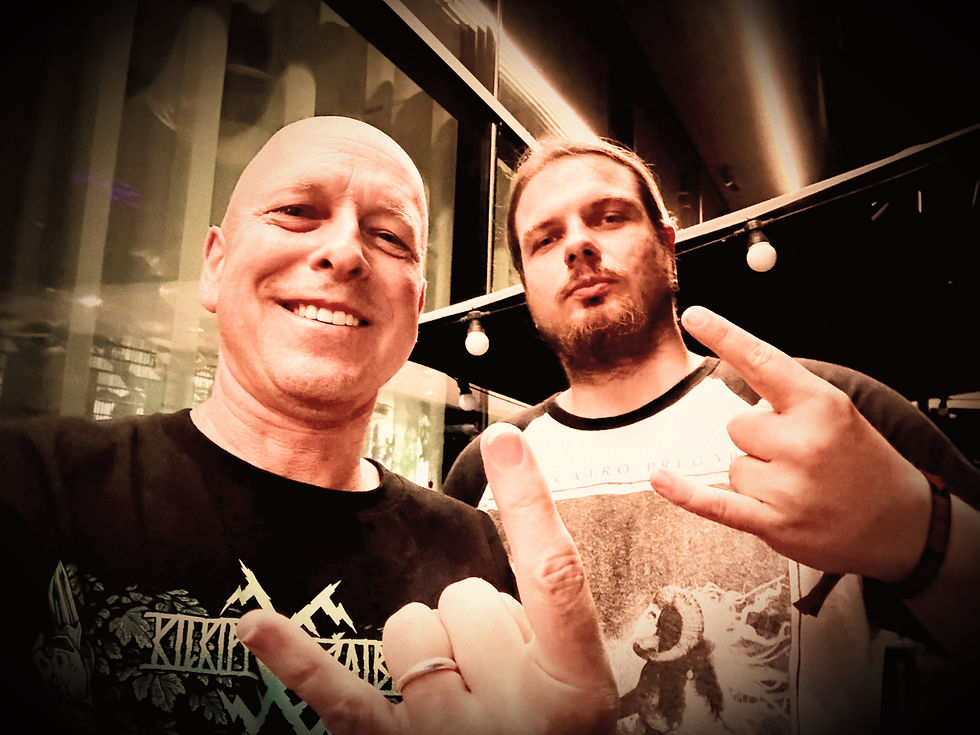
Linas, a truly solid human being, believes in being humble and gracious. He is sending me an Ūkanose shirt since I missed the merch booth somehow - salt of the earth, as the saying goes. It was well past midnight by the time I finished my beer that Linas had so graciously bought me. Linas had to be up for work in a few hours. That, more than anything he told me about Ūkanose, seemed like the point: a band built on the same instinct that drove its guitarist out on a work night to track down a journalist he'd never actually met — because the story mattered enough to finish properly.
Ūkanose's catalog — including 2023's Šiaurum Vėjum and the earlier EP ...kai Griaudėjo Miškai... — is streaming now, and the band shows no sign of slowing its festival calendar. If you get the chance to see them live, take it — and bring your own mead, because they will already have theirs.
Ūkanose | Vilnius, Lithuania | ukanose.bandcamp.com | facebook.com/Ukanose
Influences and Inspiration
Per Linas, additional music that needs a mention: Need to mention:
Žalvarinis - Už stalo sėdau (Folk metal)
Angis - Praeities Ženklai - 1. Ties Nežinomybe (Black Pagan metal)
ANDAJA - Iš Atminties (FULL ALBUM) Lithuania (Pagan black) earlier
Andaja - Perkūno Sutuoktinė (Official Lyrics Video) (Mythology rock/metal) LATER
Donis su Kūlgrinda - Sotvaras [Full album] (neo folk)
Žemaitiu ruoks by Atalyja (Neo folk)
JUODVARNIS - Audra Prieš Tylą (The Storm Before Calm) (Pagan metal earlier) Prog metal now
Girių Dvasios - Ratu [Full Album] (Folk ambient)
Pagirnis (Lithuania) - Kai milžinai gyveno (Album 2024) (PAGAN BLACK) - young generation.
Romuvos- The Return Back Home (Epic folk / Viking metal)
LIETIS – „Oželis“ live at KILKIM ŽAIBU XX (Prog folk metal)
Dega live @ kilkim zaibu, lithuania 06/21/2025 part 2 (doom folk metal)
Oi Šermukšnio by Ugniavijas (Authentic folk)

Comments