
Seventh Son: Giesinger Bräu, the Battle for the Wiesn and a Birthday Bash With Emil Bulls

Updated: 2 days ago
Every September, millions of people pour onto Munich's Theresienwiese and order a Maß (a traditional one-liter mug of beer) from one of six breweries. It has been that way for as long as most of them can remember: Augustiner, Hacker-Pschorr, Hofbräu, Löwenbräu, Paulaner and Spaten. Those six names are written into the city's Oktoberfest regulations, and only their beer may flow in the tents.
Twenty years ago a small brewery started up in a garage on the south side of town....
Today it brews protected Münchner Bier, draws its water from a deep well beneath the city, employs around 130 people and calls itself Munich's seventh brewery. It still can't sell a single glass at the Wiesn.
Giesinger Bräu wants to change that. Founder and managing director Steffen Marx answered Fermented Metal's questions and described his the long climb from that garage, the citizens' initiative the brewery hopes will open Oktoberfest's gates in 2027, and why one of Munich's best-known alternative metal bands headlined its 20th birthday party.
From a Double Garage to the Deep Well
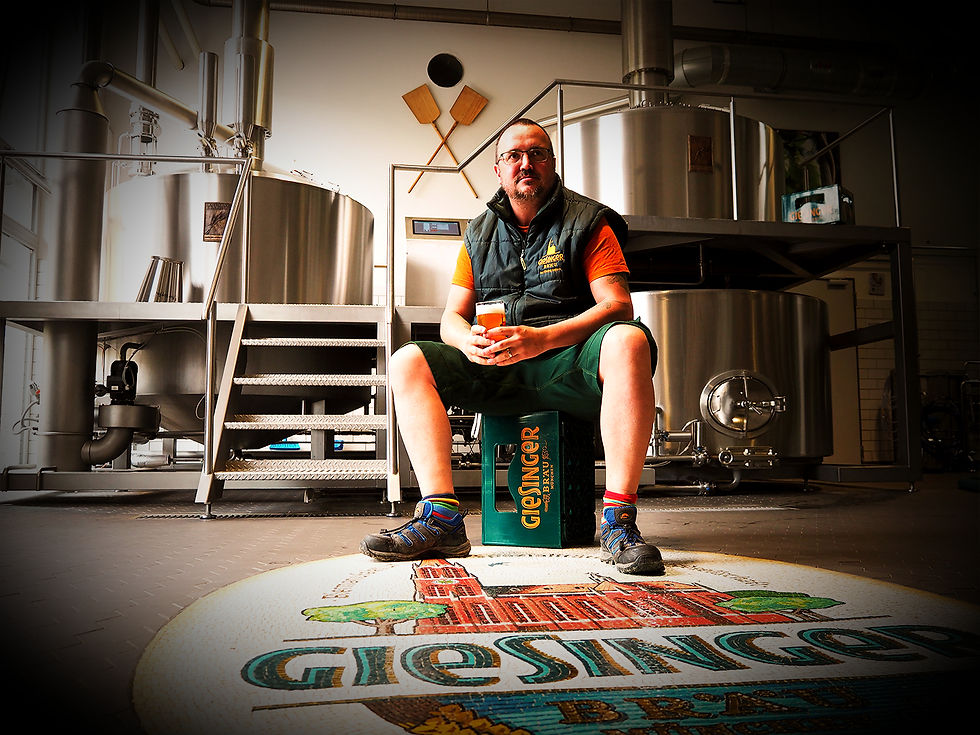
Giesinger Bräu began in 2006 in an empty double garage in Untergiesing, a working-class neighborhood south of Munich's old town, with brewing equipment the founders largely built themselves.
"We started in 2006 in a garage in Giesing with very little money and a lot of ambition," Marx says. "From there, we had to grow step by step: build a professional brewery, increase capacity, establish ourselves in Munich and, eventually, meet the requirements for brewing protected 'Münchner Bier'."
Growth came steadily. By 2011 output had passed 1,000 hectoliters and filled the original premises. At the end of 2014 the brewery moved a few minutes away to Martin-Luther-Straße in Obergiesing, where its taproom, the Schänke, still serves as the brewery's home base.
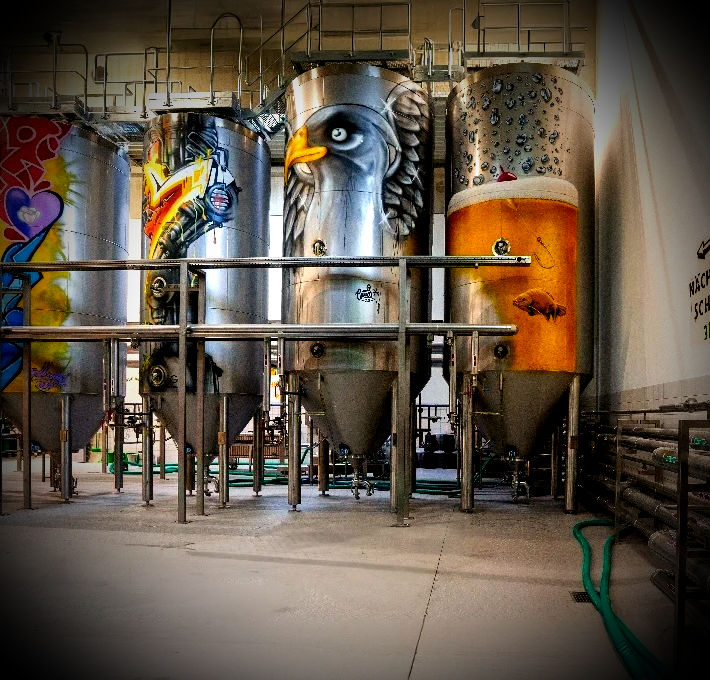
The decisive step was a second site. WERK2, at Detmoldstraße 40 in the northern district of Milbertshofen, began brewing in 2019. It was officially opened in June 2023, after the pandemic delayed the celebration. That location now produces the bulk of Giesinger's beer. More importantly, it gave the brewery something no amount of marketing could buy: Munich water.
The protected geographical indication "Münchner Bier" sets strict rules. The beer has to be brewed within the city with water from Munich's own deep wells, and a Münchner Hell has to fall within fixed limits for original gravity, alcohol and bitterness. To meet them, Giesinger drilled its own well at the end of 2019.
"Munich water is one of the requirements for Münchner Bier, so drilling more than 150 meters below the city was quite literally a deep investment in becoming a Munich brewery," Marx says.
The payoff arrived in autumn 2021, when Giesinger launched its Original Münchner Hell carrying the EU-protected Münchner Bier seal. For decades only six breweries had met those criteria. Now there were seven.
"We were 15 years old at the time, entering a brewing tradition that goes back centuries," Marx says. "We're very aware of that contrast, and we rather like it."

Today Giesinger produces around 50,000 hectoliters (1,320,860 US gallons) a year across its two sites, and it describes itself as Munich's second-largest private brewery. Its journey was documented in Straight Outta Giasing, a feature-length documentary by Raphael Lauer that opened in German cinemas in May 2024. Marx says the film has recently been made available on YouTube, "so anyone interested in how all of this happened can now watch the story for themselves."
Storming the Wiesn, One Signature at a Time
Brewing Münchner Bier gets Giesinger a lot of things. It doesn't get it into the beer tents.
"As of today, you still cannot order a Giesinger at Oktoberfest. We are working on changing that," Marx says.

The obstacle is in the city's Oktoberfest operating regulations, which limit beer sales at the festival to the six established breweries by name. Admitting another brewery would take a decision by the city council. So in February 2026, Marx used the opening of Giesinger's own Starkbierfest (strong beer festival) to launch a Bürgerbegehren, a citizens' initiative. The aim is to force a citywide vote on a simple question: should Munich allow Giesinger Bräu beer to be served at Oktoberfest from 2027?
Support built quickly. The brewery's counter showed more than 5,000 signatures after the first week and more than 10,000 by late March. By early September, reports put the total at around 21,000. The brewery estimates it needs roughly 34,000 valid signatures, and its original target was 30,000 to 40,000. If it gets there and the initiative is ruled admissible, the city council can either adopt the proposal itself or put it to voters in a referendum within three months.
Marx is careful about what the brewery is actually asking for.
"We are not asking for a guaranteed tent or a guaranteed contract. We are asking for the chance to participate."
He sees two possible routes. Giesinger could supply beer to an existing tent operator, or it could one day apply to run a tent of its own, which would mean going through the normal application and selection process. "Both are conceivable. But the first prerequisite is the same: Giesinger has to be accepted as a brewery whose beer is eligible to be served at Oktoberfest in the first place."
He's equally clear about where things stand. "There is no deal with a tent operator that we can announce today, and there is no promise from the City that Giesinger will be represented in 2027. We prefer to be very clear about that."

The City Pushes Back
Not everyone at City Hall accepts the brewery's version of events. Wiesn chief Christian Scharpf (SPD) has publicly rejected the idea that the city is blocking Giesinger. He points out that the brewery has never submitted an application through the normal process, as any other Oktoberfest vendor would, and he has called the leap straight to a citizens' initiative "befremdlich," or strange.
The politics have moved, though. Clemens Baumgärtner, a former Wiesn chief and the CSU's 2026 mayoral candidate, has softened his earlier opposition. Munich's new mayor, Dominik Krause of the Greens, said through a spokesperson after his election that any Munich brewery is free to apply, and his party's platform had already said it was open to new Oktoberfest breweries that brew Münchner Bier and meet the criteria.
"We've had discussions, we have received political support from different sides, and the debate about whether the current rules are still appropriate has become much more public," Marx says. "Compared with a few years ago, the question is now very much on the table. And we're not going away."
For him, the argument comes down to what tradition actually means.
"We don't believe tradition means that everything has to stay exactly the way it was forever. Oktoberfest itself has changed enormously over the past 200 years," he says. "We don't want to take anything away from the six traditional breweries. We simply think that a living tradition should be able to make room for something new every now and then."
In the meantime, Giesinger found its own way onto the grounds. When the 2026 Oktoberfest opened on September 19, Marx says, a group of supporters in Giesinger colors was right at the front of the traditional morning rush onto the Theresienwiese.
"So, technically, Giesinger already made it onto the Wiesn this year. Just not the beer yet."
Metal, Beer and 771 Punctured Cans
Fermented Metal readers will want to know whether there's any heavy metal in Giesinger's blood. Marx doesn't oversell it.
"We wouldn't pretend that Giesinger was founded as a metal brewery or that heavy metal is somehow written into our brewing DNA," he says. But live music has become central to what the brewery does, from Bavarian folk and brass to hip-hop, rock "or something considerably louder."
The best evidence came this summer. Giesinger celebrated its 20th anniversary with a three-day festival at WERK2 from July 24 to 26, 2026, and the Friday night belonged to Emil Bulls.
For the uninitiated, Emil Bulls formed in 1995 in Hohenschäftlarn, just south of Munich. Fronted by vocalist Christoph von Freydorf, the band has spent three decades as one of Germany's most durable alternative metal acts, moving from nu-metal-era records like Angel Delivery Service to the heavier sound of Sacrifice to Venus (2014), which reached No. 6 on the German album chart. Their most recent album, Love Will Fix It, came out in 2024. They also have a 2003 release called Mud, Blood and Beer, so the brewery booking was arguably overdue.
"If you invite one of Munich's best-known alternative metal bands to headline your 20th birthday, it's fair to say that heavier music has a place at Giesinger," Marx says.
Munich post-grunge band brain-on-a-stick and the Freakbrothers joined them on the bill.
Then the evening took a turn that was very Giesinger. The brewery had announced an official world-record attempt at Dosenstechen, the art of punching a hole in a beer can and draining it in one go, better known in English as shotgunning. The record going in, according to the organizers, was 412 participants.
On the night, 771 people stabbed their cans at the same time. Marx notes:
"Metal, beer and 771 people stabbing cans at the same time: that was a fairly memorable way to turn 20"
The rest of the weekend showed the range Marx describes. Saturday brought the anniversary edition of Giesinger's Lange Nacht der Brauereien, with independent breweries including Higgins Ale Works, Hoppebräu, Yankee & Kraut, Braumanufaktur Hertl, Tyrol's Bierol and South Tyrol's Batzen Bräu, plus live music. Sunday was a family day. Beyond the anniversary, the brewery's Schänke and WERK2 stages have hosted artists from Munich rapper Monaco F to Bavarian band Hundling, along with brass bands, rock bands and plenty of smaller local acts.
"We don't want to become a brewery that belongs to one musical genre," Marx says. "There is actually a similarity between independent music and independent brewing. You can respect tradition without wanting to sound, or taste, exactly like everybody else."
A Giesinger × Emil Bulls Beer?
So far, Giesinger hasn't released a collaboration beer with a metal band, and it hasn't brewed one with Emil Bulls. Marx doesn't rule it out, though.
"We like special beers, we like collaborations and we like working with people who have their own character," he says. "The important thing would be that it comes from a genuine relationship rather than simply putting a band logo on a bottle. If the band is excited about beer and we're excited about the band, then things can get interesting pretty quickly."
When asked directly whether a Giesinger × Emil Bulls beer could happen one day, he was quick to answer.
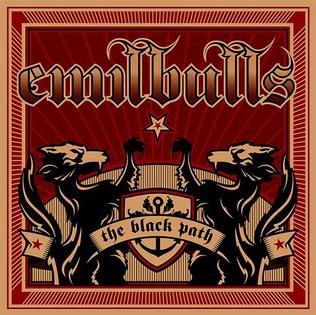
"Would we categorically rule out a Giesinger × Emil Bulls beer one day? Definitely not. We may have just given ourselves something to talk about."
Waiting at the Gates
There's a lot of metal in Giesinger's story even if the brewery won't claim the genre. A scrappy outsider spends two decades building something by hand, drills 150 meters into the ground to prove it belongs, and then takes on a centuries-old institution with nothing more than a clipboard and a lot of stubbornness.
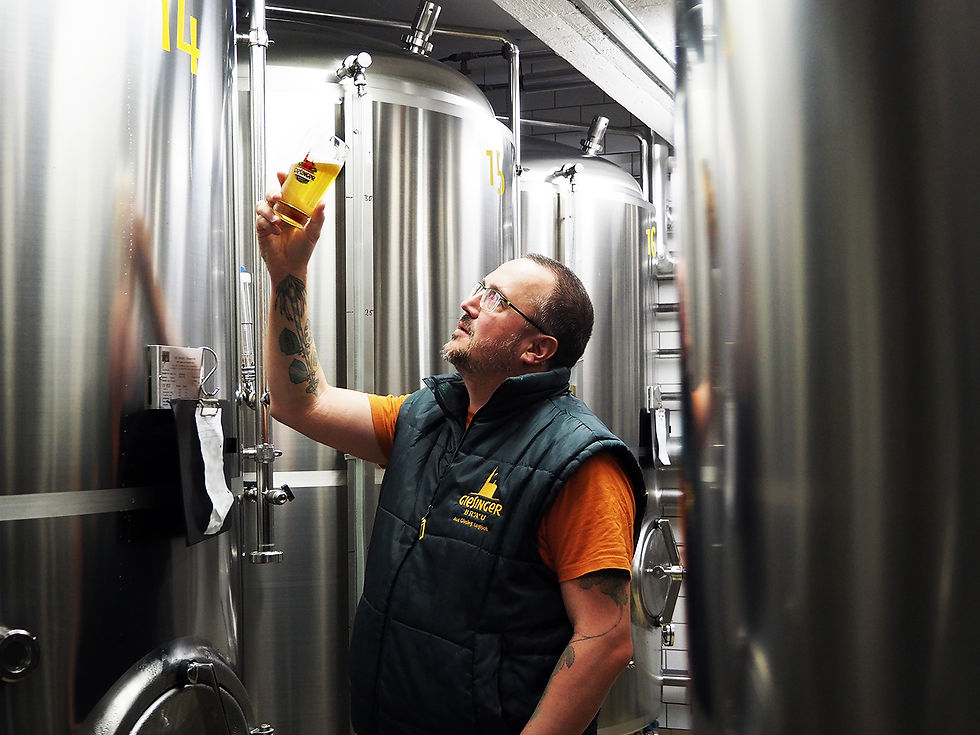
Whether Munich votes to let the seventh brewery into the Wiesn in 2027 is still an open question. The signatures have to be counted, the council has to respond, and even a yes would only be the start of the application process. But Giesinger has already shown it doesn't need anyone's permission to throw a party. It got Emil Bulls on stage and 771 people punching holes in beer cans at the same moment.The six old breweries might want to keep an eye on the gate.
Detmoldstraße 40, 80935 München, Germany

Comments