
Four Shades of Bay Area Heavy: Marrower, Theya, Kings Beneath and Prima Materia Descend on The Hub

Updated: Sep 8
The Hub RWC — Redwood City, California | August 21, 2026
Only three days after The Hub hosted a decidedly traditional-metal bill featuring Space Vacation, Tower Hill, Adamantis and Hands of Goro, the Redwood City venue opened its doors to another four-band assault. This time, however, the musical terrain was darker, stranger and considerably heavier.
On Friday, August 21, Prima Materia, Kings Beneath, Theya and Marrower gathered at The Hub for a compact survey of the contemporary Bay Area underground—one that moved through progressive doom, stoner metal, traditional heavy metal, psychedelia and blackened heaviness without sounding like four variations of the same band.

The Hub's own calendar confirms the August 21 bill, while the event listing advertised a 7 p.m. start, a $12 door price and the approximate running order of Prima Materia from 7:00–7:30, Kings Beneath from 7:45–8:30, Theya from 8:45–9:45 and Marrower from 10:00–11:00.
That progression turned out to make considerable sense on paper as well as musically. Rather than organizing four bands around a narrowly defined subgenre, the show explored several different interpretations of heaviness.
The Hub Keeps Getting Heavier
Why this location again? Two reasons:
It was on Hectic Dave's Metal Show Calendar
It is a mile walk from my house. A lot easier to get to than a Baltic Metal Fest in Lithuania..

Situated at 2650 Broadway in Redwood City, The Hub has increasingly incorporated live entertainment into its identity. Allan, the venue's owner, has said it is shifting more heavily toward events and private functions, citing changes in post-pandemic drinking habits, reduced commuter traffic and staffing challenges. Live music has become part of that strategy.
For Peninsula metal fans, that matters.
The Bay Area's heavy-music geography has traditionally pulled audiences toward San Francisco, Oakland, Berkeley and San Jose. Redwood City sits between those poles, which makes The Hub potentially valuable as something more than another bar that occasionally permits loud guitars. Two ambitious underground metal bills within four days—August 18 (Thanks to Elijah Scott of Poseurs Only Presents) and August 21 (Thanks to Ben Meiseles of Prima Materia) —Situated at 2650 Broadway in Redwood City, The Hub has increasingly incorporated live entertainment into its identity. Allan, the venue's owner, has said it is shifting more heavily toward events and private functions, citing changes in post-pandemic drinking habits, reduced commuter traffic and staffing challenges. Live music has become part of that strategy.
For Peninsula metal fans, that matters. a venue testing whether Redwood City can become a regular stop on the Bay Area metal circuit.
And on August 21, the music offered a very different proposition from the trad-metal night three evenings earlier.
Prima Materia: Building It Stone by Stone
Prima Materia—guitarist/vocalist Esther Ann Gove, drummer Matt Silver and new bassist
Benny Pepper—opened the evening with their Oakland-bred strain of progressive doom and post-metal.
The trio released its debut record, Stone by Stone, on February 14, 2025. Its six tracks stretch doom outward toward progressive and stoner-metal territory; the band's own Bandcamp tags include doom metal, progressive metal, stoner doom and stoner metal.
That makes Prima Materia difficult to reduce to the usual equation of slow tempo plus enormous riff.
The band's recorded material plays with weight and space. Songs such as “Blame,” “Silence,” “Stone by Stone,” “Ruinbound” and “Lie” favor shifts in texture and dynamics over straightforward repetition. Independent coverage of Stone by Stone has similarly described the group as operating in a more unusual corner of doom, with progressive tendencies woven through the heavier foundations.
As the first act of the evening, Prima Materia therefore established an important principle for what followed: this was going to be a heavy show, but heaviness would not mean the same thing for every band.
Their half-hour slot also gave the night a particularly Oakland beginning. Prima Materia's Bandcamp identifies the group with Oakland, putting them within a local lineage where doom, sludge, psychedelic music and experimental metal have long existed comfortably alongside the Bay Area's much more famous thrash tradition.
Esther Ann Gove and Matt Silver Bassist Benny Pepper Matt Silver and Benny Pepper
Kings Beneath: Doom From the South Bay
Next came Kings Beneath, carrying the show's center of gravity south to San Jose. Well, to be honest, after briefly talking to their guitarist Tony Vienckowski, it appears that their members travel from very different parts of the Bay Area to practice in San Jose; that is commitment.
Formed in 2024, Kings Beneath describe their foundation as doom and stoner-rock riffs combined with lyrical themes drawn from fantasy, science fiction and history. The band comprises of Cameron Cheney on vocals, Tony Vienckowski on guitar, Adam Thomas on drums, and Kirk Tautz on bass (who also ran sound for the night!).
Kings Beneath made its recorded debut with “Oathbreaker,” released September 22, 2025. The track runs a little over four minutes and represented the band's first commercially distributed single. Amazon Music confirms the September 22 release date and a running time of approximately 4:15.
Even the title fits neatly within the band's stated aesthetic. “Oathbreaker” immediately evokes betrayal, broken allegiance and the sort of quasi-historical or fantasy imagery that has been part of heavy metal storytelling for decades.
Rather than immediately flooding streaming services with material, Kings Beneath followed the single-release approach—a practical strategy for a young independent band still establishing both its sound and its audience.
The second Kings Beneath single, “Evil Machine,” arrived April 24, 2026. At approximately 4:22, it became the band's newest officially released recording and, as of August 2026, remains its latest release on the major streaming platforms. Apple Music lists both Evil Machine and Oathbreaker in the band's discography, while Amazon identifies Evil Machine. as a Kings Beneath release dated April 24.
The two titles also hint at the breadth promised in the band's own description.
Where Oathbreaker sounds as though it could belong to an ancient kingdom or sword-and-sorcery story, Evil Machine suggests something more mechanical or science-fiction oriented. That movement between fantasy, history and technology appears to be an important part of Kings Beneath's developing identity.
A. t this stage, however, Kings Beneath remains very much an emerging independent band. Only those two singles could be reliably verified through major streaming sources, and there does not yet appear to be a full-length Kings Beneath album in general distribution. Likewise, reliable publicly indexed sources do not currently provide enough information to confidently document the band's complete membership or individual musicians' backgrounds, so those details should not be stated as fact without confirmation from the band.
Doom and stoner metal frequently draw power from repetition and atmosphere, but Kings Beneath's emphasis on narrative subjects gives the material another dimension. Fantasy and history naturally complement the monumental quality of doom riffs; science fiction introduces machinery, futurism and a different kind of menace.
Placed between Prima Materia and Theya, Kings Beneath also functioned as a bridge in the evening's sequencing. Prima Materia leaned toward the progressive and esoteric side of doom, while the band that followed would turn much more decisively toward classic heavy metal. Kings Beneath occupied the territory between them: riff-centered, heavy and rooted in doom, yet still connected to the storytelling instincts that have been part of traditional metal since its earliest years.
Cameron Cheney and Kirk Tautz Tony Vienckowski and Adam Thomas Adam Thomas on drums Kings Beneath - The Hub RWC
Theya: Old Metal Language, New Bay Area Voice
If there was one band on the bill whose influences could send an old-school metal listener reaching for familiar reference points, it was Theya.
Theya traces its beginnings to 2018, when longtime friends Tuula Paivio-Ala and Michael Scanland found themselves between bands and finally acted on a long-standing desire to make music together. Paivio-Ala's baritone guitar work and Scanland's bass became the foundation of the project. Drummer Mic Rawls subsequently joined, followed by vocalist Samantha Grove and second guitarist Tobias Wettstein, completing the lineup described by the band today.
The current lineup:
Samantha Grove — vocals
Tuula Paivio-Ala — guitar
Tobias Wettstein — guitar
Michael Scanland — bass
Mic Rawls — drums
Rather than identifying with a single subgenre, Theya describe their music as a collision of New Wave of British Heavy Metal, thrash, doom, MC5-style rock ’n’ roll and classic psychedelia. That combination is useful shorthand, but the band's defining characteristic may be the way those influences interact. Traditional-metal melody can sit alongside slow, heavy riffs, psychedelic passages and more unruly garage-rock energy. Spanish publication Dirty Rock Magazine, reviewing the debut, similarly noted shifts between hard rock and heavy psych while emphasizing the record's underlying weight and density.
The public trail toward the band's debut album became clearer in 2024, when Theya released demos of several songs that would eventually appear on the record: “1000 Miles (Words of White),” “Permafrost,” “The Oak Tree at the End of the Lane” and a version of Dio's “Caught in the Middle.”
That Dio connection is especially revealing. Theya's musical world reaches well beyond traditional metal, but the band's decision to record “Caught in the Middle” makes its affection for classic heavy metal explicit. The song originally appeared on Dio's 1984 album The Last in Line. Theya's finished album credits the composition to the original Dio-era writers, while Grove handles the vocals with Paivio-Ala, Scanland and Rawls forming the instrumental core.
The demos eventually developed into Theya Vol. 1, released April 17, 2026 through Heavy Sounds, Inc. The ten-track album runs approximately 50 minutes.
The album was recorded, mixed and mastered by Tim Green at Louder Studios. Green's résumé includes work associated with artists such as The Melvins, Earthless and The Fucking Champs, making him a logical match for a band attempting to bridge underground metal and psychedelic heavy rock.
What separates Theya from a straightforward retro-metal act is the conceptual world surrounding the riffs.
The band's lyrics and imagery move through mythology, cosmic consciousness, science fiction, Jungian archetypes and fever-dream symbolism. Theya specifically cite characters inspired by author Philip K. Dick, while other songs explore artificial intelligence, ecological collapse and fantastical landscapes. The band's own presentation casts its members in archetypal forms including the Witch, Warrior, Horseman and Wizard, giving Vol. 1 something closer to a self-contained mythological environment than simply a collection of songs.
Those concepts are easy to hear across the record.
Fro example, here are two songs that were part of the setlist on that Friday night:
“Permafrost” imagines a future in which humanity disappears while the planet continues without it—a bleak ecological vision involving thawing earth, revived bacteria and a natural world reclaiming itself.
“Jupiter,” meanwhile, moves fully into science fiction. Its narrator dreams of escaping a dead Earth while encountering a bionic rival and a robotic-handed “space prophet,” fitting neatly with the band's acknowledged fascination with Philip K. Dick-style speculative fiction.
There is something distinctly old-school about Theya, but not because the band sounds tied to one particular year.
Instead, Theya seem interested in an older way of experiencing heavy music: albums as complete works, expansive songs, strange artwork and lyrics worth reading while the record plays. Their own biography invokes the ritual of dropping a needle onto a record and absorbing every lyric, riff and melody—a telling statement from a group whose debut stretches several songs beyond the six-minute mark.
San Francisco's metal history inevitably creates a long shadow. Bands emerging from the region can easily be framed in relation to the thrash explosion that transformed the Bay Area during the 1980s.
Theya are more interesting when viewed outside that narrow lineage.
Their music suggests a broader Bay Area tradition—the willingness to mix styles, treat heavy music as something exploratory and build a distinct identity rather than conform to a single scene. Thrash is part of Theya's vocabulary, but so are doom, British heavy metal, psychedelic rock and the dirty rock ’n’ roll attack associated with the MC5.
With Vol. 1, Theya have essentially issued their opening statement: heavy metal can still be melodic, strange, philosophical, psychedelic and fun at the same time.
For a band that began as two longtime friends finally deciding to make music together, the journey from a 2018 idea to a fully realized 2026 album has been a long one. But that gestation may explain why Vol. 1 feels less like a tentative debut than the introduction to a world Theya have already spent years constructing.
And in true heavy-metal fashion, that world contains witches, warriors, frozen civilizations, cosmic prophets, artificial intelligence, monsters—and, naturally, a Dio song.
Marrower: Into the Burning Ship
Closing the night was Oakland's Marrower, and the stylistic transition was noticible.
Where Theya celebrated much of heavy metal's traditional vocabulary, Marrower moved toward its more extreme edges.

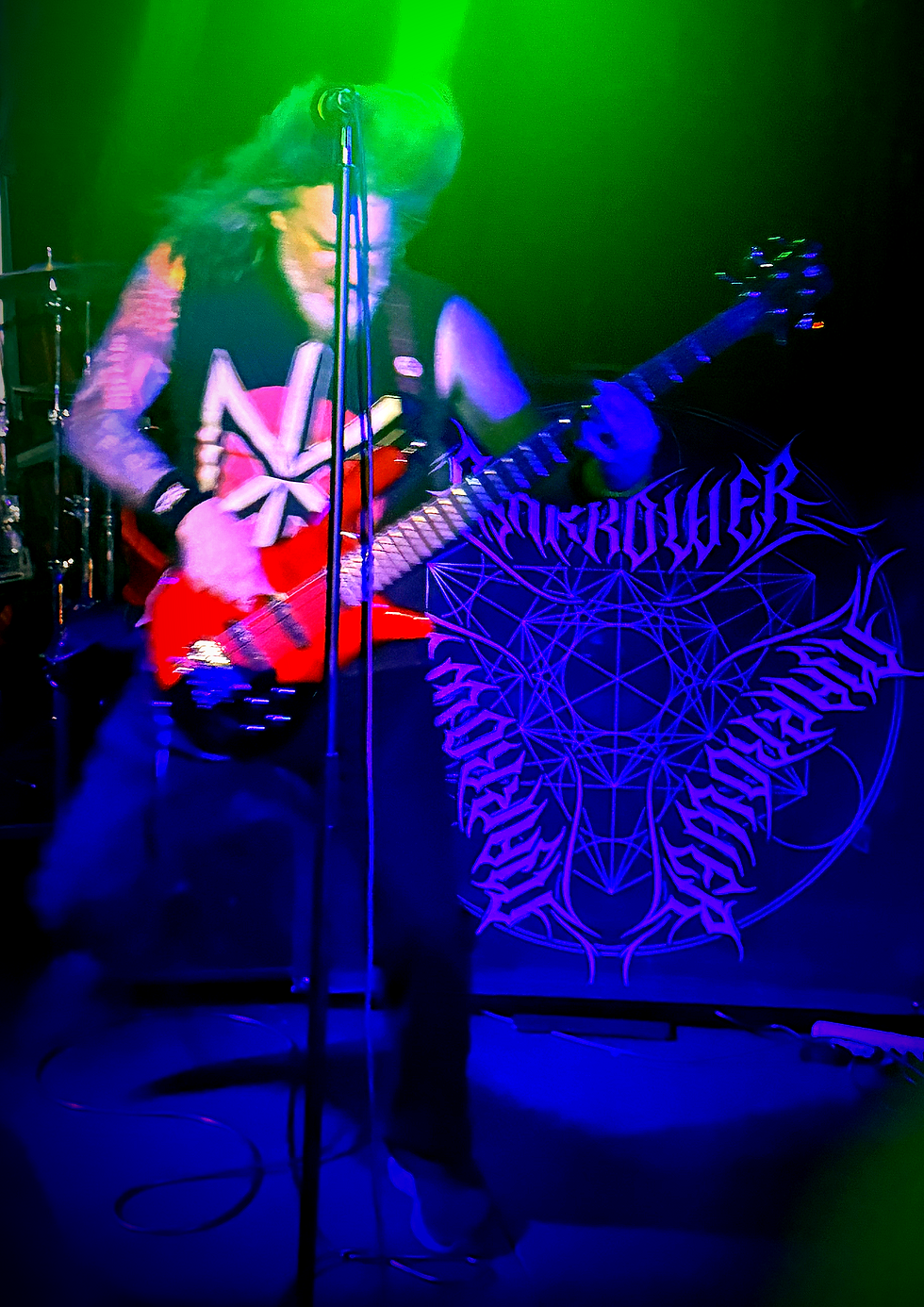
The trio identifies itself as progressive blackened doom, bringing together vocalist/guitarist Max Hodes, bassist/vocalist Terry Goss and drummer/vocalist Nick Benigno.
Their debut album, The Burning Ship, arrived on September 27, 2024, and its scale says plenty about the band's ambitions. The ten-track record includes compositions approaching or exceeding eight, nine and ten minutes, including “Darkness, My Witness,” “Nausea” and the sprawling “Growing Old Without Her.”
Calling The Burning Ship simply a doom record undersells what Marrower is attempting.
The band's own Bandcamp tags include black metal, doom, progressive metal, sludge, stoner, psychedelic and psych-metal elements. An independent review by The Progressive Subway heard still more ingredients, comparing portions of the album to the melodic death metal of Scar Symmetry, the epic doom of Khemmis and the progressive heavy metal of Nevermore.
That stylistic movement may be Marrower's defining characteristic.
“Darkness, My Witness” and “Swallowing the Sun” push toward faster melodic-death-metal territory, while “Crawling Home” moves closer to expansive epic doom. Hodes' vocal approach similarly avoids a single formula, moving between rough-edged melodic singing and harsher extreme-metal vocals.
The result is music that can feel traditional and experimental at the same time: recognizable metal ingredients rearranged into lengthy, frequently changing compositions.
There is also a considerable emotional dimension to the record. The enormous closing “Growing Old Without Her,” the somber “Holy Offer” and the ominous atmosphere running throughout The Burning Ship keep the record from functioning simply as an exercise in technical musicianship.
Since the release of The Burning Ship, Marrower has steadily appeared around Northern California, playing venues including Bottom of the Hill in San Francisco, Eli's Mile High Club in Oakland, the SF Eagle and the Ivy Room in Albany. The band also appeared at San Francisco's Mabuhay Gardens in June 2026 as part of a bill with The Human Contortion, Disgorged Carnage and Under Ego.
FYI: The distinctive Marrower logo was created by extreme-metal logo artist Christophe Szpajdel.
What I witnessed first hand, was that Goss played the bass with extreme ferocity, like a man possesed. I later told him after the show that, "I haven't seen bass playing like that since Eddfest.." Goss gives Marrower another substantial connection to the Bay Area metal underground. He and Benigno already play together in Earth Crawler, the San Francisco thrash/groove-metal band formed in 2016. Goss has additionally played with Hate FX, Scorched-Earth Policy and numerous earlier California projects.
That shared history should make Marrower's current rhythm section considerably more than a newly assembled partnership.
Marrower remains an unsigned, independent band, and at present its officially documented discography consists primarily of The Burning Ship and its associated singles. I found no reliably sourced announcement of a second Marrower album as of August 2026.
For a young band, however, Marrower already has something considerably more important than a neatly defined genre.
It has an identity.
The transition from Vannon to Marrower, the ambitious hour-long debut, the shift to a new bassist and the band's continued movement through Northern California's clubs all suggest a project still evolving in public. Doom, black metal, melodic death metal, progressive metal and classic heavy-metal instincts all pass through the music, but none completely takes control.
That unpredictability may ultimately be Marrower's strongest asset. In a Bay Area scene famous for creating new sounds by ignoring the boundaries between old ones, Marrower is doing exactly what a local metal band should: taking familiar ingredients, making them heavier, stranger and more personal, and seeing where the resulting music leads.
Max Hodes lets loose Cameron Cheney headbangs to Marrower Max lays down some sick licks Terry Goss, madman on bass! Nick Benigno on drums and vocals
Marrower's usefulness as a headliner went beyond simply being the last band on the bill.
Their music pulls together elements that are frequently treated as separate metal territories: black-metal abrasion, doom's weight, progressive composition and psychedelic atmosphere. The result isn't easily summarized with a single adjective. It can move from aggression toward introspection and from density toward comparatively spacious passages without abandoning its central sense of unease.
That made Marrower a logical conclusion to a night whose bands became progressively harder to categorize.
Prima Materia began by bending doom.
Kings Beneath placed enormous riffs inside fantasy and science-fiction storytelling.
Theya pulled classic metal, psychedelia and rock and roll together.
Marrower then took the entire idea of heaviness somewhere colder and more emotionally severe.
Four Bands, Four Versions of Heavy
Perhaps the smartest thing about the August 21st lineup was precisely what it didn't do:
There was no single stylistic template.
In underground metal booking, genre consistency can sometimes become predictability: four death-metal bands, four doom bands or four traditional-metal bands separated primarily by logos and guitar tones. The Hub's August 21 bill instead demonstrated how wide the term “Bay Area metal” has become.
That phrase will probably always evoke Metallica, Exodus, Testament, Death Angel and the thrash explosion of the 1980s. But focusing exclusively on that history risks overlooking what is happening in small rooms now.
Here were bands from Oakland, San Francisco and San Jose, none of them trying to reproduce the classic Bay Area thrash formula. Prima Materia works from doom and progressive metal. Kings Beneath builds from doom and stoner riffs. Theya reaches back toward NWOBHM and heavy psychedelic rock. Marrower pushes toward progressive blackened doom.
They share geography and heaviness more than they share genre.
And that may be the more interesting snapshot of Northern California metal in 2026.
Camera lights for Prima Materia Marrower Merch Cameron talks to Sam and Tuula after the show
Something Is Happening at The Hub
The August 21st show becomes even more significant when viewed alongside what happened at the same venue only three nights earlier.
On August 18th, The Hub hosted Space Vacation, Canada's Tower Hill, Boston's Adamantis and Hands of Goro. On August 21st came Prima Materia, Kings Beneath, Theya and Marrower. The venue's calendar then continued into September with Darkness Everywhere and Barbarous on September 4, followed the next night by Vesseles, Post Heaven, Eaten By Insects and Darandaz.
That begins to look less like an accidental run of metal shows and more like the early stages of a pattern.
By any means, nobody should declare Redwood City the Bay Area's newest metal capital just yet. But underground scenes don't begin with declarations. They grow when bands have rooms to play, promoters have rooms to book and fans have reasons to return.
For two nights during one week in August, The Hub provided exactly that.
And while August 18 celebrated the ringing guitars and heroic vocabulary of traditional heavy metal, August 21 showed another side of the same underground: slower, stranger, darker and more difficult to categorize.
Unfortunately Fermented Metal will not be there on either night, as we are covering the first Iron Maiden, Megadeth, and Anthrax US show in New Jersy on that same night. So for me...

Darkness Everywhere and Barbarous

Vesseles, Post Heaven, Eaten By Insects, Darandaz


Comments