
Phrenetix: Forged by Loss, Driven by Thrash, and Still Moving Forward

Updated: Aug 25
Lithuania has produced no shortage of dark, extreme and unconventional heavy music, but few bands are quite like Phrenetix. Emerging from Vilnius more than a decade ago, the quartet has gradually built an identity around technical musicianship, old-school thrash energy and an increasingly adventurous approach to songwriting. Their story, however, begins somewhere much heavier than music...

Before Phrenetix existed, vocalist and guitarist Lina Vaštakaitė played in a young band called State of Ruin. In 2011, two members of State of Ruin were killed in a car accident in England. After the tragedy, Vaštakaitė and drummer Jonas Gedvilas faced an awful choice: stop, or somehow continue.
They continued.
According to guitarist Paulius Navickas, who answered Fermented Metal's questions about the band's history, that decision became the foundation upon which Phrenetix was eventually built.

“Afterwards, the remaining members Lina and Jonas had to decide — either it was time to give up, or pull through the grief and keep pushing,” Navickas explained. “They chose the latter, and here came Phrenetix.”
“There was no one point that changed the band into what we are today,” he says. “It was a continuous process of keeping together through the good and bad times. We all grew up together as musicians and have a special bond created by love for music.”
That may be the most useful way to understand Phrenetix: not as a band built around one lucky break, but as one accumulated through survival.
From Fear to Something More Complicated
The first major outside validation arrived when French label Infernö Records took notice of Phrenetix.
Their debut full-length, Fear, was released through the label on November 11, 2015. The eight-track record established Phrenetix as a serious Lithuanian entry in the international thrash revival, mixing speed and aggression with melodic guitar work and traces of the New Wave of British Heavy Metal. Contemporary Lithuanian metal publication Ferrum ranked Fear among the country's strongest heavy releases of 2015 and described the record as a genuine breakthrough for the band.
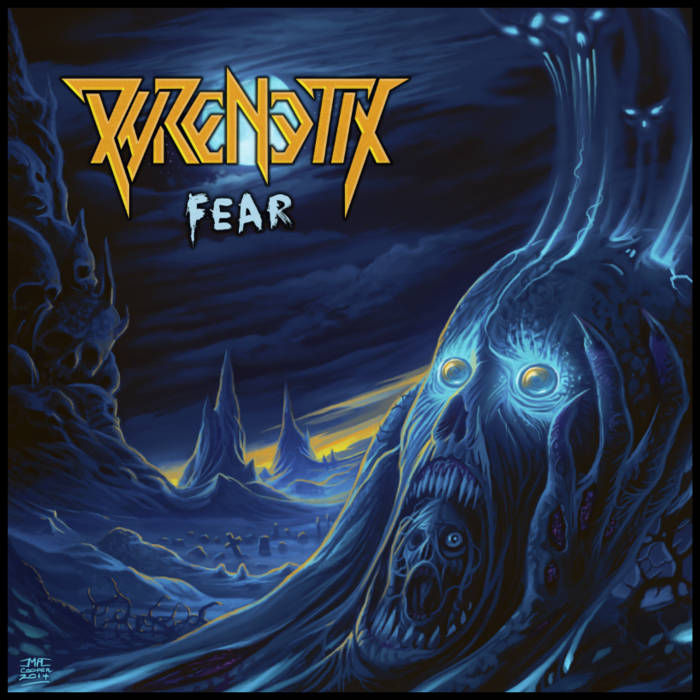
Navickas remembers the label's involvement as a particularly significant moment in the band's history.
“If we would take some special moments, the first real one was being seen by Fabien from Inferno Records and releasing our first album with him,” he says. “That was a big morale boost right when we really needed it.”
More milestones followed.
Phrenetix supported Testament in 2016. Two years later, the band won Lithuania's Wacken Metal Battle, earning the right to represent the country at Wacken Open Air in Germany. Wacken's own announcement described Phrenetix as Lithuania's finalist and noted both their appearances at festivals such as Devilstone and Kilkim Žaibu and their previous show with Testament. Phrenetix were no longer simply a promising local thrash band.
They had become one of Lithuania's representatives abroad.
Yet rather than making the obvious follow-up to Fear, Phrenetix complicated things.
Their second album, Exuviae, arrived on October 7, 2021. Its nine tracks stretched the band's writing into more elaborate and experimental territory. Songs including “Yellow Eyes,” “Blaze of Alienation” and “Hallucigenation” demonstrated just how far the group was willing to move beyond a straightforward old-school thrash template. Navickas describes Exuviae as both an achievement and something of an endurance test.

That experience appears to have changed the band's philosophy.
After what Navickas calls the “intense experimenting and complicated songwriting” of the Exuviae period, Phrenetix have deliberately begun stripping the process back.
“Now the band tends to take a simpler approach — not overthink, just get the song out as naturally as we can.”
That does not necessarily mean simpler music.
It means less forcing of it.
Lina Vaštakaitė and the Phrenetix Sound
One constant throughout Phrenetix's evolution has been Lina Vaštakaitė.
Navickas identifies her as the band's principal songwriter: the person who generally arrives with the initial riffs and musical ideas before the rest of the group shapes them into finished Phrenetix songs.

“Lina was always the main songwriter,” he says. “She is the one who brought ideas and riffs to the band and it is her authenticity and the chemistry between the other members that makes our music stand out the way it can.”
Calling Phrenetix simply “thrash metal” is therefore accurate but incomplete.
The starting point is obvious enough. Metallica were formative for both Vaštakaitė and Navickas. For Lina, it was footage of Metallica performing “For Whom the Bell Tolls” in 1984. For Paulius, it was the band's legendary 1989 Seattle performance.
“I couldn't believe what I was seeing,” Navickas remembers. “I couldn't believe that it was actually a real thing that happens. I think I decided that I wanted to become a musician right there and then.”
From there came Anthrax, Megadeth, Testament and a much wider collection of influences.
Navickas points particularly to Megadeth and Marty Friedman in Phrenetix's intricate guitar work, while the band's rhythmic “polka beats” owe something to Anthrax and Slayer.
But things quickly become less predictable.

There are flashes of pop in “Yellow Eyes” and “Blaze of Alienation.” Navickas hears an unmistakable System of a Down influence in “Hallucigenation.” The first album carries considerable NWOBHM DNA. Elsewhere the band's listening ranges through Leprous, Ghost, Tool, Death, Rainbow and Mastodon.
And then there is Chick Corea.
“One part in ‘Yellow Eyes’ came from a jazz fusion pianist Chick Corea,” Navickas reveals.
It is a small detail that explains a lot about Phrenetix.
The group respects thrash's vocabulary without treating it as a set of restrictions.
Kilkim Žaibu: Playing at Home
That combination of tradition and experimentation made Phrenetix a natural fit for Lithuania's Kilkim Žaibu, a festival that has evolved into one of the Baltic region's important gatherings of metal, folk, history and pre-Christian cultural traditions.
Phrenetix first played Kilkim Žaibu around 2014, while still relatively inexperienced.
“We were still a very young band and not ‘quite there’ yet,” Navickas recalls. “But the fact Daividas and his crew saw the potential in us was very motivating...”
The band has subsequently returned every few years.
“...Kilkim Zaibu became the most important metal festival in Lithuania, perhaps even the Baltic states,” he says.

Their relationship with the festival continued in 2026, when Phrenetix took the Pikuolis Stage from 5:00 to 6:00 p.m. on Friday, June 26. The festival itself introduced the group as “one of Lithuania's finest thrash metal bands,” while its artist profile praised the band's combination of technical, fast thrash with progressive ideas and a highly energetic live presence. For Phrenetix, Kilkim Žaibu offers something more personal than another festival slot.
Of being invited back, Navickas says, “...it is motivating and it's an honor. For us, every time we can meet friends, fans, organisers, other bands in such a positive atmosphere is just a great way to fill up on good energy. It is a rewarding experience. And as a metal band - even better! Not only do you have a great crowd, but you are given a chance for a great sound, production and a good stage, which you cannot enjoy everyday. So it is always a celebration."
I managed to catch up with Lina for a few moments after Phrenetix’s set. I found her charming, approachable, and funny—a far cry from the persona who belts out a scratchy growl on the albums. We were interrupted a few times by fans heaping praise on her and asking for autographs. While we were talking about the band’s upcoming new music, I pointed out a fan Lina hadn’t noticed standing behind her: a girl of about five or six. She immediately turned and gave the little girl her undivided attention.

What really convinced me that Lina was my kind of people came moments later. After signing an autograph for another fan, she added a little drawing of a face with a “kiss.” After the fan left, she immediately realized the kiss might actually look more like an “asshole.” A brief moment of embarrassment crossed her face, before she burst out in laughter, I couldn’t help but doing the same....

One of the unexpected highlights of Phrenetix’s Kilkim Žaibu 2026 set came when Marijus Berenis joined the band onstage as a special guest. A veteran of Lithuania’s heavy-music scene, Berenis is best known to metal fans for his early work with Regredior and Ghostorm, before later becoming widely recognized through ŽAS and Lithuanian radio and television. His appearance with Phrenetix is a bridge between generations of Lithuanian metal, connecting one of the country’s earlier extreme-metal figures with a band that has carried that underground spirit into the present.

Up Next for Phrenetix?
The most important chapter may now be the unfinished one.
In September 2025, Phrenetix released the single “Rise,” the band's first major recorded statement following Exuviae. The recording features Vaštakaitė, Vizbaras, Navickas and Martynas, and provides a useful preview of the production direction Phrenetix intends to carry into its next release. According to Navickas, the group is now completing a new EP.
“We are in the final stages of recording our new EP,” he says. “The mixing and mastering shouldn't take long after that, since our latest single Rise is already a template for the rest of the songs.”
There is an interesting transitional quality to the project.
The EP's material dates from the period when former drummer Martynas Stoškus was still in the band. Rather than representing the beginning of Phrenetix's next phase, finishing it effectively closes the previous one.
“The point of finishing this EP is to move forward,” Navickas explains. “We are already writing new songs for our next release.”
The philosophy governing those newer songs sounds distinctly different from the painstaking construction behind Exuviae.
"The main difference is that the new songs are written more naturally - what comes out is what it is, in contrast with the previous albums, which were done in a complicated and very thought out way. We never try to make a specific kind of style, that is we don’t try to get heavier, or more melodic or whatever. We never say - the next album will be like this. It is always how it turns out, that is what it will be. But I think it will be a bit heavier and more punk-driven!"

That makes sense considering what the band has been listening to lately. Navickas says hardcore punk has begun creeping into their collective consciousness — not necessarily as a genre Phrenetix intends to adopt, but as an attitude.
They want the energy.
More. Shows. MORE.
Phrenetix's ambitions are refreshingly uncomplicated.
After surviving tragedy, personnel changes, self-doubt, depression, difficult recording periods and the familiar frustration of trying to push an independent metal band forward, their primary objective remains the thing that started all of it.
Playing.

“The stage is where we feel meaningful,” Navickas says. Support from friends, fans and the wider metal community has increasingly made Phrenetix feel less isolated in that pursuit. “More and more we feel as one and it makes it much easier to enjoy the process and keep going.”
The immediate plan is to complete and release the EP, continue writing with Gediminas Tumėnas fully integrated into the creative process, and perform wherever possible.
And five years from now?
Navickas doesn't describe major-label deals, gigantic festivals or some carefully constructed version of success.
“Where it is now, but better,” he says. “Still active, still with a strong relationship, but even more shows.”
Then he puts it somewhat more emphatically:
“More. Shows. MORE!”

For a group whose very existence began with the decision to keep playing when stopping would have been entirely understandable, it is difficult to imagine a more appropriate philosophy.
Phrenetix have spent more than a decade twisting thrash metal into their own shape — first looking backward toward Metallica, Megadeth, Anthrax and the NWOBHM, then outward toward progressive metal, alternative music, jazz fusion and now hardcore punk.
Yet beneath all those influences remains something considerably simpler.
Four people still want to get on a stage, turn everything up and play.
After everything Phrenetix has been through, perhaps that is the band's greatest victory.


Comments